The Rings of Power Season 3, Episodes 1-4 Review: Middle Earth is Moving Faster, Getting Darker, and I’m Loving the Journey!
Our spoiler-filled Rings of Power Season 3 Episodes 1-4 review explores Sauron, the Nazgul, Gandalf, Theo, and why Middle-earth’s journey is worth watching.
Images Subject to Copyright. All Rights Reserved to Original Owner.
WARNING: Major spoilers ahead for the first four episodes of Season 3 of The Lord of the Rings: The Rings of Power!
I’m going to start this review the same way I approach most of my reviews.
I’m not giving it a star rating.
I watched it. I liked it. And I think you should watch it!
Is it perfect? Of course not. Are there things I would have done differently? Absolutely. But four episodes into the third season of The Lord of the Rings: The Rings of Power, I’m having a great time being back in Middle-earth. And here’s something that became apparent almost immediately.
This season is moving!
The first two seasons spent considerable time establishing characters, kingdoms, relationships, and the political landscape of Middle-earth. Now it feels like we’re beginning to see all those pieces move toward the events we know are coming.
And considering how much history the series needs to cover over its planned five-season run, a faster pace makes perfect sense.
I’m a fan of that decision.
So let’s talk about the first four episodes, what worked, what didn’t, and where I think we’re heading.
Episode 1: Catching Up, Setting the Stage, and Introducing Something Terrifying
The season premiere is largely a catch-up episode, and that’s perfectly fine.
We discover that Sauron has established control over a significant amount of territory, but there’s still one very important problem standing between him and his ultimate goal. He hasn’t figured out how to create the rings he needs.His plan appears to involve stealing one of the three Elven rings and reverse engineering its power.
And here’s my first prediction of the season.
I think Sauron finally forges the One Ring in the season finale.
How we get there is anybody’s guess, but that feels like the natural destination for everything we’re watching unfold. Of course, the biggest highlight of this episode for me was the beginning of the Nazgûl. Now THIS is something I’ve been waiting to see!
We know the Ringwraiths from The Lord of the Rings, but there’s still so much mystery surrounding who they were before becoming Sauron’s most terrifying servants. Getting an opportunity to explore their origins is exactly the kind of storytelling I want from this series.
And the confrontation involving Arondir, Galadriel, and a single Nazgûl was fantastic! The way he moves immediately brings back memories of the Ringwraiths from Peter Jackson’s films.
But there’s a difference.
This one feels considerably more imposing.
More powerful.
More dangerous.
And that makes sense to me. We’re watching the earlier history of these creatures, and I love the idea of seeing them at a different stage of their existence.
The episode also begins planting seeds involving Pallando, another character whose story has remained largely mysterious. Expanding on the Blue Wizards and their role in Middle-earth is something I’m absolutely interested in. Overall, Episode 1 does exactly what it needs to do. It reminds us where everybody stands and begins setting up the conflicts that will drive the rest of the season.
Episode 2: Númenor Struggles, Durin Delivers, and Theo Becomes Very Interesting
Of the first four episodes, this might be my least favorite.
But remember, I’m pretty easily entertained!
So when I say it’s the weakest, I’m not suggesting it’s dramatically worse than the others. There are just a few storylines that aren’t working as well for me. The biggest one is Pharazôn and his supporters in Númenor.
I’m simply not finding this group particularly imposing. Knowing where Númenor’s history is headed, I have a difficult time believing that these people are capable of taking control and ultimately destroying the faction loyal to the Elves. Maybe that will change as the season progresses, but right now I’m not entirely sold.
Then we get to Khazad-dûm.
And honestly?
Anytime Durin is on my television screen, I’m having a good time! I love this character. I’m interested in seeing where the storyline involving his brother goes, even though this is one of those moments when my familiarity with Tolkien’s history makes things a little complicated.
The brother and his particular role in the kingdom are inventions of the television series rather than established parts of the history I’m familiar with. And sometimes that’s difficult for me.
Not because I’m opposed to new stories, but because I know the larger history and wonder how these additions are supposed to fit into it. Still, I’m open to seeing where the writers take us.
And then there’s Theo.
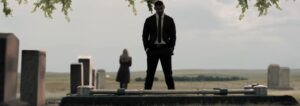
Going into this season, I wasn’t entirely sure what the writers intended to do with him. Now? Well, suddenly the idea that Theo could become the Witch-king is looking awfully interesting! I have to admit, when I look at Theo without the hood and armor, I have trouble imagining him becoming the terrifying leader of the Nazgûl.
But put that gear on him?
Everything changes.
Suddenly I’m not looking at Theo anymore. I’m looking at the most powerful Ringwraith in Middle-earth. And that’s a pretty incredible transformation.
We also get an intriguing turncoat Orc storyline, which becomes considerably more important as the next episodes unfold.
Episode 3: Gandalf, the Secret Fire, and the Mysteries of the Istari
Anybody who knows me knows that I’m always interested in learning more about Gandalf. So naturally, this episode had plenty to keep me entertained.
We get additional exploration of the Secret Fire and its connection to Eru Ilúvatar, the supreme creator in Tolkien’s mythology. I love when this series ventures into the deeper mythology of Middle-earth. There’s an entire spiritual and cosmic history behind the world of The Lord of the Rings, and most casual viewers have barely scratched the surface of it.
We also learn more about Pallando and the possibility that he killed another Istari. But what really interests me is Gandalf’s apparent purpose.
He’s not necessarily there to destroy Pallando. He may be there to save him. That’s a much more interesting direction for the story.
And then there’s Tom Bombadil!
I absolutely love the relationship between Gandalf and Tom. Everything seems to involve riddles, mysterious observations, and conversations that make you wonder whether Tom knows considerably more than he’s willing to reveal. Which, of course, is exactly how I like my Tom Bombadil!
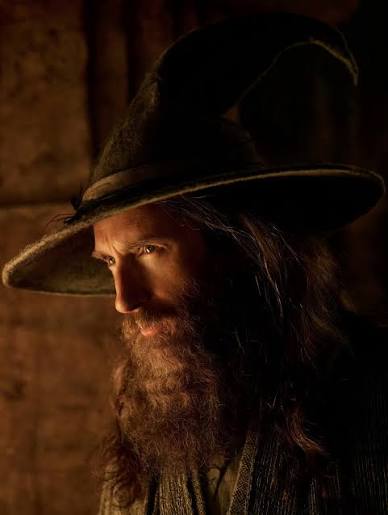
And we finally get a wonderful look at Gandalf in his familiar clothing, complete with that hat!
There he is!
That’s the Gandalf we all know and love!
The struggle between the Nazgûl and Pallando also raises some fascinating questions. We know the Nazgûl are powerful, but are they really more powerful, or more magically capable, than an Istar? That’s an interesting development, and one I’m curious to see explored further.
My biggest criticism of Episode 3 involves the Elves and Orcs. There’s a lot of walking, hiding, and evading danger without many answers. I understand the purpose of building suspense, but this portion of the episode felt like it was dragging.
Fortunately, Episode 4 makes that storyline considerably more worthwhile.
Episode 4: Betrayal, Heartbreak, and the Rise of a Ringwraith
Now we’re talking!
Episode 4 delivered some of my favorite material of the season so far. But first, let’s get the part I didn’t particularly enjoy out of the way.
Khazad-dûm.
Unfortunately, the Dwarven storyline was probably the weakest part of this episode. From the beginning, it seemed fairly obvious that Thráin was going to take control. And the romantic disagreement that ultimately contributed to Durin’s downfall felt a little forced. Here’s my problem.
Durin is a king.
He understands the consequences of his decisions, and he knows how important it is to maintain control of himself. Yet he allows his anger to get the better of him at exactly the wrong moment. I understand that even kings make mistakes, but this particular development didn’t work especially well for me.
Still, I’m not particularly worried.
I’m predicting Durin takes back the crown before the season ends.
We’ll see if I’m right!
Now let’s get to the storyline that absolutely made this episode.
Galadriel, Arondir, and the Orc.
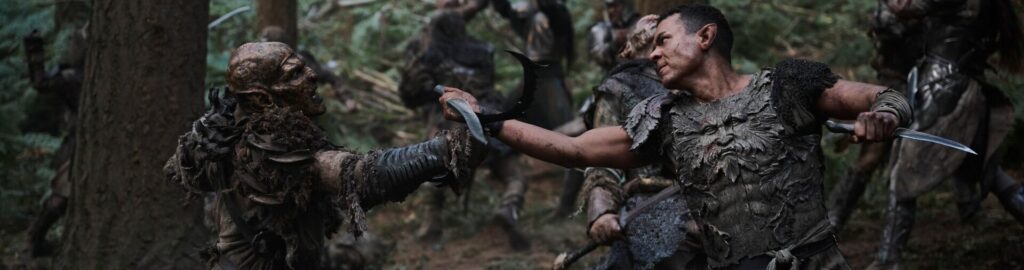
What initially appears to be a fairly predictable double-cross turns into something considerably more interesting. Because the Orc isn’t actually betraying them the way we expect. He’s helping them!
It’s an unexpected triple-cross, and I loved it.
Even better, we get a surprisingly touching moment between Arondir and the Orc. Arondir saves him more than once and ultimately tries to bring him along to safety.
Think about that.
An Elf attempting to save an Orc.
That’s exactly the kind of moment that makes me appreciate what this series is trying to do with the people and creatures inhabiting Middle-earth. For all the battles, kingdoms, and ancient rivalries, these characters are still capable of surprising us.
And then Sauron arrives.
With Theo.
And suddenly everything changes.
Theo’s Transformation Is Heartbreaking, Even If We Saw It Coming
Let’s be clear. The reveal that Theo has become the Nazgûl was not particularly difficult to predict. I think many of us saw it coming from a mile away. But knowing something is coming doesn’t mean watching it happen can’t still be devastating. And this was devastating.
Sauron has completely taken control of Theo.
The young man we’ve watched struggle to find his place in Middle-earth is now being transformed into something terrifying.
And then Sauron makes him kill Arondir.
Oh, come on!
That one hurt.
I’ve enjoyed Arondir since his introduction. He’s been one of the more interesting Elven characters in the series, and I particularly appreciated the way his storyline allowed us to see Middle-earth from a different perspective.
His compassion toward the Orc only made what happened next more heartbreaking. And ending the episode with that close-up of Arondir dying?
That was rough.
Really rough.
I know some viewers may have predicted the entire sequence, but I don’t think predictability automatically makes a scene ineffective. Sometimes the emotional impact comes from knowing exactly what’s about to happen and being unable to do anything but watch. And that’s what this moment accomplished for me.
Sauron Is Becoming the Dark Lord We’ve Been Waiting For
One of my favorite things about these first four episodes is watching Sauron become increasingly imposing. We’re no longer simply dealing with a mysterious figure manipulating events from the shadows. We’re watching someone consolidate power, establish territory, and begin assembling the forces that will eventually threaten all of Middle-earth.
And those Nazgûl!
They look fantastic.
They’re frightening, powerful, and visually connected to the Ringwraiths we remember from the films without feeling like simple copies.
I love that we’re getting more of their history. I love that we’re seeing the process of their corruption. And I love that the series is allowing them to become something genuinely terrifying.
The production design continues to impress me as well. The sets are gorgeous. The environments feel enormous. And the visual presentation of Middle-earth remains one of the strongest things about this entire series.
Whether we’re exploring the Dwarven halls of Khazad-dûm, the political struggles of Númenor, or the growing darkness surrounding Sauron, this world looks incredible.
Knowing the Ending Doesn’t Ruin the Journey
Here’s where I probably disagree with some of the show’s loudest critics.
I know where much of this story is going.
I’ve read Tolkien and own almost all of the published material.
I’ve watched the movies.
I know what happens to Númenor.
I know what happens to the Rings of Power.
I know the fate awaiting many of these kingdoms and characters.
And you know what?
That doesn’t spoil the series for me. It makes me more excited to watch it!
Because I’m not watching simply to find out what happens. I’m watching to discover how this interpretation gets us there. I want to see the relationships develop. I want to understand the motivations. I want to explore characters who received relatively little attention in the stories we already know.
And I especially want to learn more about the parts of Middle-earth’s history that Tolkien left mysterious or only briefly described. That’s one of the greatest opportunities this series has.
Can We Please Stop Acting Like Enjoying This Show Is a Crime?
I know there are people who absolutely hate The Rings of Power.
And that’s fine!
Nobody has to enjoy every television show.
But there’s a difference between not liking something and insisting that nobody else should like it either. I’ve heard the arguments.
It’s not canon.
They changed the history.
They invented characters.
Tolkien never wrote that!
And yes, the series takes liberties with the source material. Some of those choices work better than others. I’ve pointed out several things in these first four episodes that I didn’t particularly enjoy.
But sometimes I have to chuckle at the confidence with which certain fans insist they understand Middle-earth better than the people actually developing this adaptation.
The involvement of Tolkien’s estate in the larger production doesn’t mean every creative decision is automatically correct. And being familiar with the books doesn’t mean viewers have to accept every change.
But it also doesn’t mean an adaptation is worthless simply because it explores material differently.
There’s room for interpretation.
There’s room for new characters.
And there’s certainly room to tell stories within a world that has inspired generations of readers, filmmakers, artists, and fans.
I love Tolkien’s work.
That’s exactly why I enjoy spending more time in Middle-earth. And I’m not going to let somebody else’s definition of what is or isn’t acceptable prevent me from enjoying it.
Four Episodes Down, and I’m Ready for More!
So where do I stand after the first four episodes of Season 3?
Pretty much where I hoped I’d be. Excited! The faster pacing is working for me. Sauron is becoming more dangerous. The Nazgûl are fantastic. Gandalf and the mysteries surrounding the Istari continue to fascinate me. And the different pieces of Middle-earth’s history are beginning to come together in ways that make me eager to see what happens next.
Are there weaker storylines?
Absolutely.
Do I love everything happening in Númenor or Khazad-dûm?
Not particularly.
And am I still trying to figure out exactly how some of these invented characters will fit into the larger history?
You bet!
But none of that changes the fact that I’m enjoying the journey. I think we’re heading toward the forging of the One Ring in the season finale. I think Durin will reclaim his crown. And I think we’re only beginning to understand just how terrifying Sauron’s Nazgûl are going to become.
Maybe I’ll be right.
Maybe I’ll be completely wrong.
Either way, I can’t wait to find out.
The Rings of Power isn’t perfect. But it’s definitely not trash.
It’s another opportunity to spend time in a world I’ve loved for years, explore characters I’ve always wanted to know more about, and watch the history of Middle-earth unfold.
And sometimes, that’s more than enough.
Stop worrying so much about whether you know Middle-earth better than everybody else, and give yourself permission to enjoy the adventure.
I certainly am!